

Contact Us

What do you
need to launch
an OTC desk?

A proper OTC desk should be designed as an operating model. Before launch, firms need to define who they serve, how prices are sourced, how trades are executed, where assets are held, how settlement is completed, and how risks are monitored.

Before Now
  • Chat-based trading
  • Manual spreadsheets
  • Scattered exchange accounts
  • Manual settlement
  • Liquidity access
  • Price discovery
  • Trading technology
  • Settlement processes
  • Compliance controls
  • Reporting
  • Risk management
Viable only for a limited pool of trusted counterparties. Scalable to a broad client base with absolute operational control as volumes grow.
01.

Liquidity access

Liquidity is the foundation of an OTC desk. Without reliable liquidity, the desk cannot provide competitive quotes, support larger trade sizes, or maintain consistent execution quality across market conditions.

The key question is not only how many liquidity sources are connected, but whether they can provide competitive pricing, minimize slippage, sufficient depth, fast response times, and stable service during volatile periods.

Firms can source liquidity through:

icon

Direct relationships with market makers and liquidity providers

icon

Crypto exchanges

glow Liquidity
icon

Other OTC desks

icon

Crypto ECNs

02.

Price discovery
and trading workflows

Most OTC desks rely on a request-for-quote model, where the client asks for a price on a specific asset, size, and trading pair. The desk then sources or generates a quote and executes the trade once the client accepts it.

This process needs clear rules. The desk must define how long quotes remain valid, whether prices are firm or indicative, how rejected or expired quotes are handled, and how execution is recorded. These details are important because they shape client trust and protect the desk from unnecessary operational disputes.

03.

Trading infrastructure

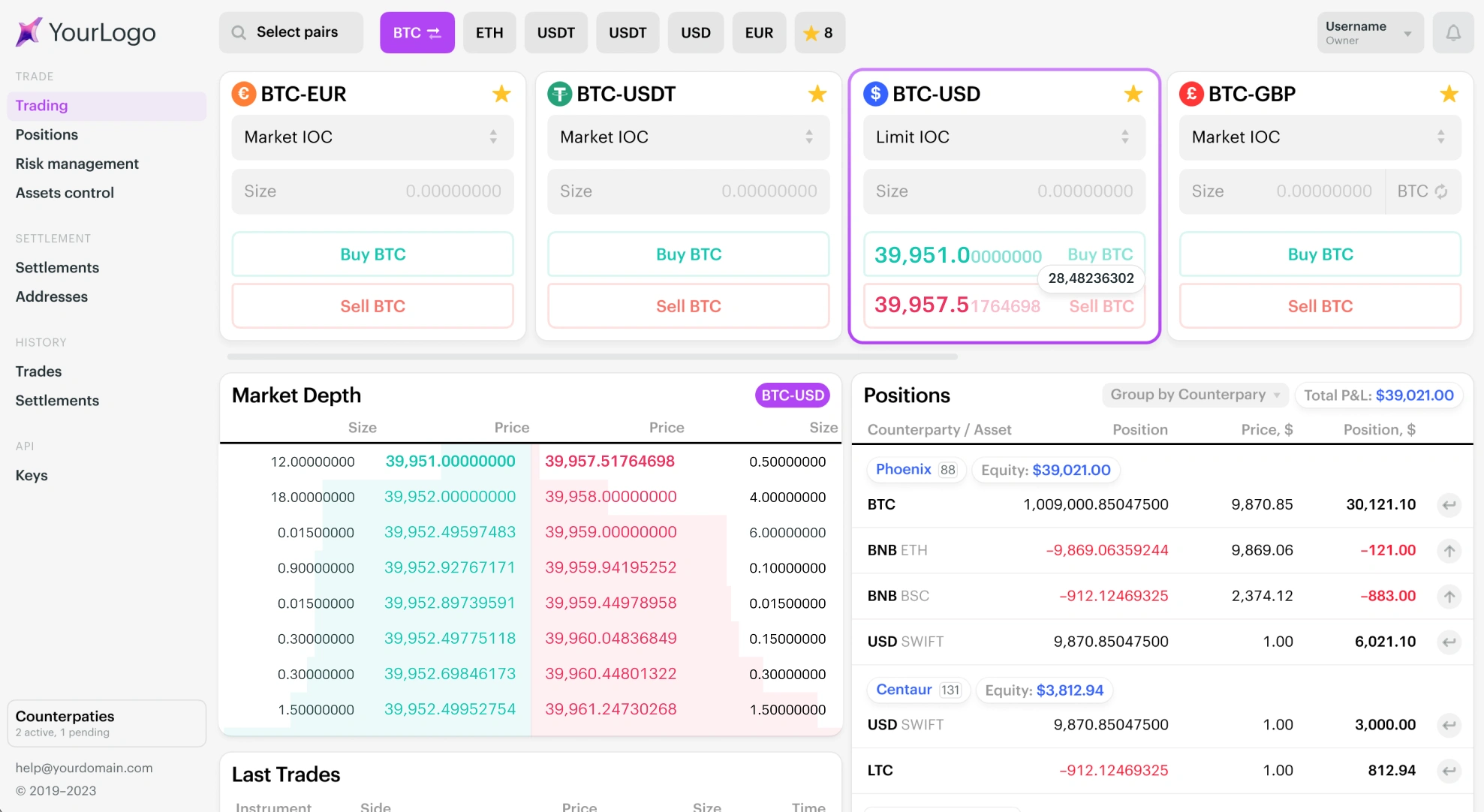
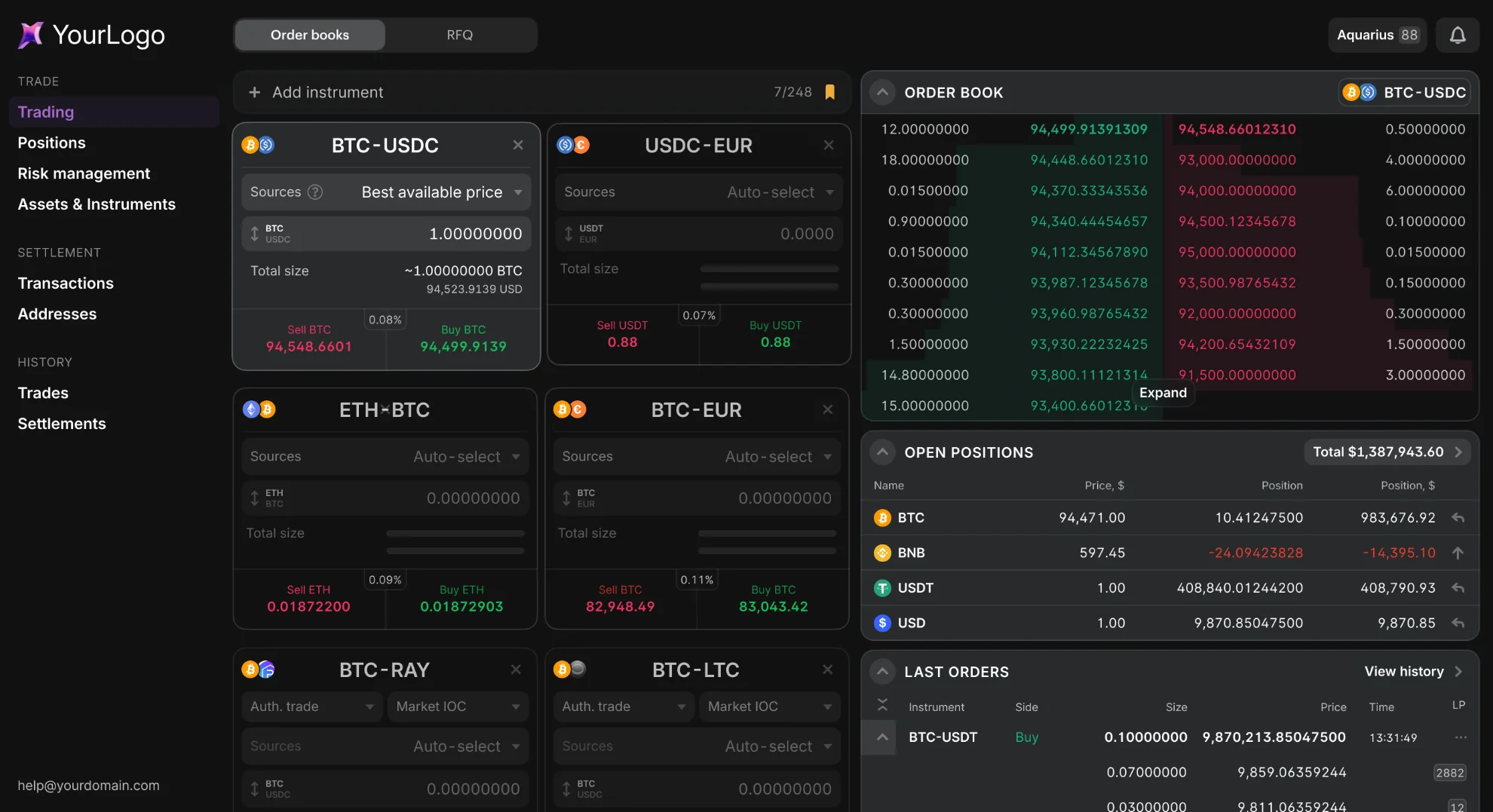
The trading layer determines how the desk manages quotes, orders, execution, permissions, and post-trade reporting afterwards. As the desk adds clients, assets, and liquidity sources, it needs to process more requests without creating bottlenecks for traders, operations, or compliance teams.

Small-scale OTC desk B2B and large-scale B2C OTC desk
  • manual tools for chat-based trading
  • manual onboarding
  • pricing
  • trade history and reporting
  • user roles
  • dedicated platform with a GUI
  • API connectivity
  • onboarding tools
  • internal dealer tools (e.g. spread management)
  • trade history
  • audit trails
04.

Settlement and custody
workflows

Execution is only one part of OTC trading. Once the trade is agreed, the desk needs to move assets and funds according to the agreed settlement process. This may involve crypto wallets, bank transfers, custodians, settlement partners, or internal treasury accounts.

The desk needs to know when clients must deliver funds, when assets are released, how failed settlement is handled, and who approves each step. Poorly defined settlement processes can create delays, credit exposure, and client dissatisfaction.

05.

Risk management

An OTC desk takes on several types of risk, including market risk, counterparty risk, settlement risk, operational risk, and technology risk. These risks increase as trade sizes grow or as the desk serves more complex clients. The goal is not to remove risk completely, but to make sure the desk knows where risk sits and how it is controlled.

06.

Compliance
& client onboarding

Before serving clients, an OTC desk needs a clear compliance framework. In practice, the compliance framework dictates far more than just client onboarding—it shapes the entire operational model of the OTC desk.This includes KYC and KYB checks, AML screening, sanctions controls, transaction monitoring, jurisdictional restrictions, and internal record-keeping.

Compliance should not be treated as a separate step after launch. It affects who the desk can serve, which assets and pairs it can offer, how transactions are monitored, and what information must be collected before execution. For institutional clients, strong onboarding and compliance processes are part of the product experience.

Prior to the first execution, the desk must thoroughly evaluate the counterparty's risk profile. This involves verifying:

  • icon Corporate identity and jurisdiction of incorporation

  • icon Regulatory licensing and Ultimate Beneficial Owners (UBOs)

  • icon Target client base and source of funds (SoF)

  • icon Intended fiat/crypto asset pairs and jurisdictions involved

  • icon Transaction monitoring protocols for inbound and outbound flows

07.

Direct impact on execution
and settlement

These factors directly determine liquidity provider mapping, counterparty trading limits, supported instruments, wallet whitelisting, and settlement workflows. For instance, exposure to third-party wallets, high-risk sectors, or non-standard jurisdictions triggers Enhanced Due Diligence (EDD). This requires advanced AML/KYT screening, comprehensive source-of-wealth documentation, and formal internal risk approvals.

Compliance is not a post-onboarding formality. It is the foundational infrastructure that governs client eligibility, trade execution, credit line allocation, and the post-trade data architecture required for seamless audit and accounting.

Control vs speed:
white label crypto OTC Desk

Once the business case is clear, the next decision is how to launch the OTC desk itself. In practice, firms usually face two options: build the trading infrastructure internally or use white-label OTC desk infrastructure from a specialized provider. Both models can work, but they lead to very different timelines, cost structures, and operational responsibilities.

Building internally gives a firm more control over product design, client workflows, integrations, and long-term roadmap. This can be attractive for companies with large technology teams, established liquidity relationships, and enough time to develop, test, and maintain their own execution stack. However, it also means taking responsibility for every layer of the OTC desk: trading interface, pricing engine, liquidity connectivity, user permissions, reporting, uptime, security, compliance integrations, and ongoing product support.

For many businesses, the bigger challenge is not launching a basic interface, but building the infrastructure required to operate reliably at institutional scale. OTC trading depends on execution quality, speed, price consistency, settlement discipline, and operational control. If these elements are not in place, the desk may struggle to serve larger clients even if demand exists.

White-label OTC desk infrastructure offers a different path. Instead of building the full technology stack from scratch, a company can launch a l branded trading environment on top of existing institutional infrastructure. This allows the firm to keep ownership of its client relationships and commercial strategy while relying on a proven technology for execution, liquidity access, reporting, and operational workflows.

Building an OTC desk
from scratch

Building from scratch may be the right choice for firms that want complete ownership of the technology layer and have the internal resources to support it. This route can offer flexibility, but it usually requires significant investment before the desk can generate meaningful revenue.

Key requirements include:

  • icon developing the trading interface and internal dealer tools;

  • icon connecting to liquidity providers and market makers through API;

  • icon building pricing, RFQ, and execution logic;

  • icon setting up reporting, reconciliation, and audit trails;

  • icon integrating compliance, custody, and settlement workflows;

  • icon maintaining infrastructure, security, and uptime;

  • icon staffing technology, product,
    trading, operations, and support teams.

The main risk is time to market. While the firm is building, competitors may already be serving the same client demand. Internal development can also become more complex as the desk adds more assets, pairs, clients, and liquidity relationships.

Launching with
a white-label OTC desk

A white-label OTC platform allows a firm to launch a crypto trading service under its own brand without developing the core infrastructure internally. The provider supplies the execution technology, UI platform architecture, and often access to an existing liquidity network, while the client-facing company manages its own market positioning, customer relationships, and commercial model.

This model is especially relevant for brokers, payment providers, fintech companies, banks, EMIs, and crypto businesses that already have a client base but do not want to spend years and millions building an institutional trading stack.

A white-label model can also reduce operational complexity. The firm still needs clear compliance, settlement, and internal risk processes, but it does not need to build every technical component itself. This can make the launch process faster, more predictable, and easier to scale.

The key trade-off:
speed vs control

The choice between building and using white-label infrastructure is not simply a question of cost. It is a strategic decision about where and how the firm wants to create value. For most companies entering the OTC market, the goal is not to avoid complexity entirely. It is to place complexity in the right layer. Client relationships, positioning, pricing strategy, and market expansion can remain with the business, while the execution infrastructure is supported by a specialized technology provider.

Building from scratch White label solution
Control over product & roadmap Accelerated launch and time-to-market
Extended development and testing timelines Reduced technical load and engineering overhead
Full operational responsibility across all layers Vendor alignment focus (matching provider tech to internal standards)
Ongoing maintenance and infrastructure burden License and software platform costs